Lecture & Workshop mit Jérôme Noetinger (host Volkmar Klien) | Koordination Volkmar Klien
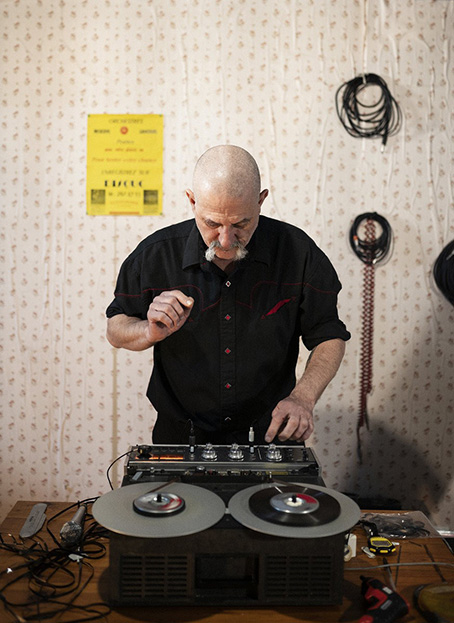
Jérôme Noetinger (1966) is a composer, improviser and sound artist who works with electroacoustic devices such as the Revox B77 reel-to-reel tape recorder and magnetic tape, analogue synthesisers, mixing desks, speakers, microphones, various electronic household/everyday objects and home-made electronica.
He performs both solo and in ensembles (Cellule d'Intervention Metamkine, Le Un, Hrundi Bakshi, Les Sirènes…), and collaborates often (Sophie Agnel, Angélica Castelló, dieb13, Lionel Fernandez, Anthony Laguerre, Lionel Marchetti, Anthony Pateras, Aude Romary, Petr Vrba).
From 1987 to 2018, he was the director of Metamkine, a non-profit organisation dedicated to the distribution of improvised and electroacoustic music.
Between 1987 and 2014 Jérôme was a member of the editorial committee of the quarterly journal of contemporary sound, poetry and performance, Revue & Corrigée.
For ten years from 1989, he was a member and programming co-ordinator of exhibitions, gigs, and experimental cinema at le 102 rue d'Alembert, Grenoble.
https://www.jeromenoetinger.fr/
The primary function of the Revox B77 tape recorder (manufactured between 1977 and 1986) is to record and play back sounds in what is known as high-fidelity quality. I've been working with it since the late 80s, and as my practice has developed, I've taken this tape recorder on stage to play with it, and so instrumentalise it.
I can record live using different types of microphone (dynamic, contact, electromagnetic, etc.), divert other audio sources (audio player, telephone, radio, etc.), and of course instrumental sources too.
I work with loops, which means I can record and listen to the recording straight away, changing the playback, speed, scrolling, etc. You're in direct contact with the sound. You're in direct contact with the sound via the magnetic tape.
It's an act of recuperation and misappropriation in the great tradition of the 20th-century avant-garde.
This workshop will offer an introduction to this magnetohone, followed by a group session of electroacoustic improvisation.
How do you turn a machine designed to record and reproduce an audio signal into a sound-generating machine?
And let's not forget that in experimental music-making, the process of making is as important, if not more important, than the result.
Gastkurs, Workshop, Tagung, Symposium
Wann und Wo: 12.11.2025 - 14:00 - Sonic Lab
Abhaltungsstatus: fix
Kosten: Eintritt frei
Veranstalter: Komposition, Dirigieren und Computermusik
Kontakt: Klien, Volkmar; Univ.Prof. Mag. PhD.
Themen: Vortrag, Workshop